
Working with Existing Architecture: Paris and the Pyramid
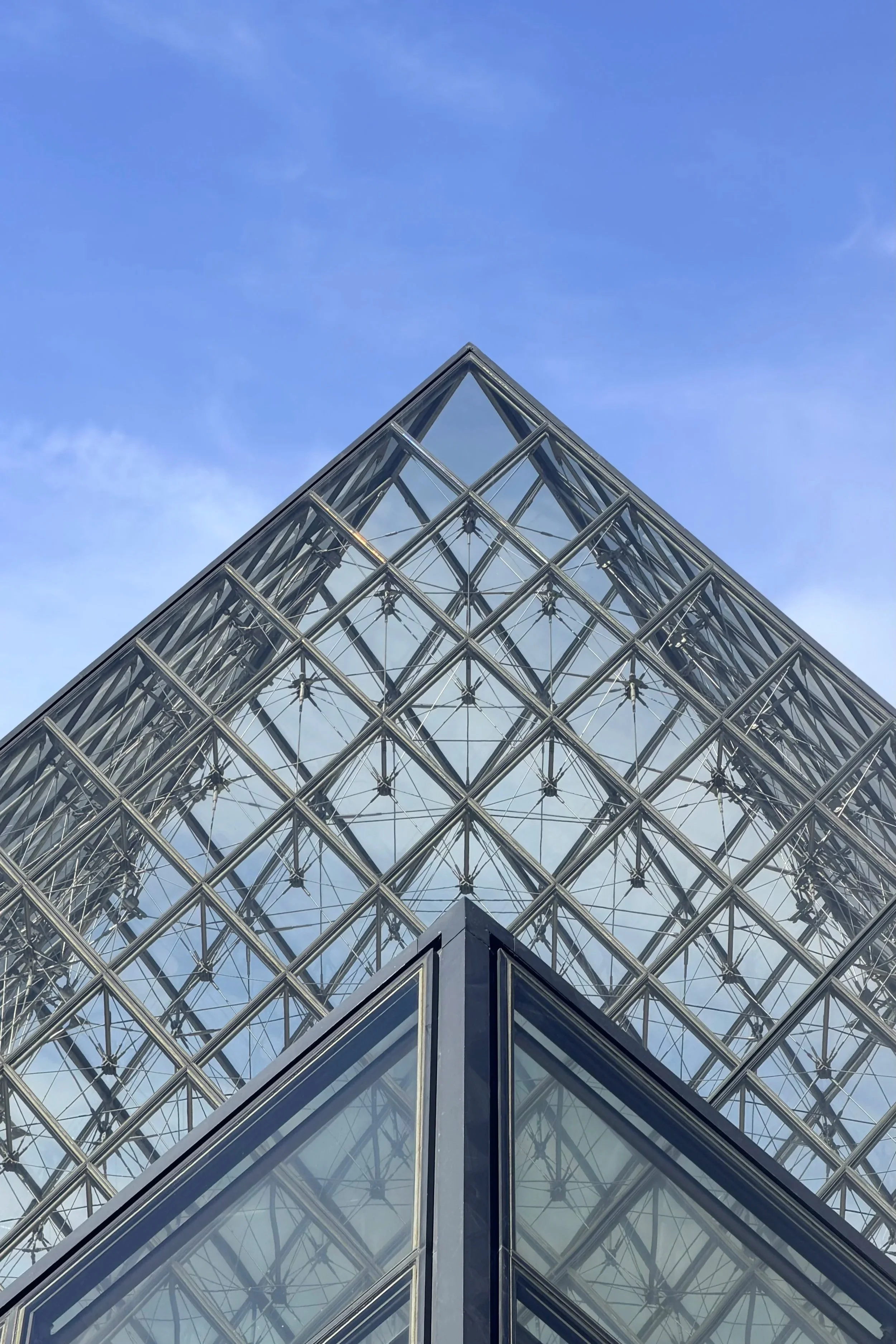
There is a moment, approaching the Louvre, when the city begins to align itself. The long axis of Paris extends with quiet authority, from the Arc de Triomphe through the obelisk at Concorde, resolving at the courtyard of the palace. For someone arriving from Australia, where public space rarely carries this weight of time, the scale is disarming. It recalls something older than Europe itself, the ordered procession of Karnak or Luxor, where movement is not incidental but deliberate, ceremonial. The courtyard holds this same gravity. The pyramid sits at its centre not as an object placed, but as something anchored, inevitable, as if the geometry had always been waiting for this position. It establishes a point of arrival within a field of history, reinforcing symmetry rather than disrupting it. In this sense, Pei’s intervention is less an insertion and more an act of alignment, completing an order that was already latent.
What is striking is the restraint of the gesture. Against the density of the baroque facades, with their relief, ornament and accumulated detail, the pyramid offers almost nothing. No decoration, no narrative, no attempt to echo the language around it. It is pure geometry, a primitive form reduced to line and plane. And yet, this absence becomes its strength. The transparency of the glass allows the palace to remain visually continuous, the architecture behind never obscured, only reframed. The eye, searching for detail, slips past the surface and returns to the façades with greater intensity. Even the precision of the glass joints, the fine calibration of its structure, operates at a different register to the carved stone. It is not competing, but calibrating the field of perception. The pyramid does not imitate the past, nor does it oppose it. It clarifies it. In doing so, it reveals a confidence, that contrast, when handled with discipline, can be a form of respect.
Beneath this clarity lies a more radical move. The true connection between old and new is largely hidden, resolved below ground where the complexity of circulation is absorbed and reorganised. The pyramid becomes the threshold to this system, a singular point of entry that transforms what was once a fragmented experience into a coherent sequence. Once inside, the order and restraint only begin. The entry hall unfolds as a gridded, vaulted concrete structure, measured and deliberate, with smaller pyramidal skylights placed with precision above. Light is controlled, orientation is immediate, and the vastness of the museum is distilled into something legible. What was once a rambling accumulation of galleries becomes clear, open, navigable. It offers a moment of relief, almost a pause, a kind of spatial palate cleanser between the intensity of the collections.
There is a lesson here for renovations, even at the scale of a private house. In our own work, entry is never simply functional. It is a moment of orientation, transition and meaning. What Pei demonstrates is that working with existing architecture does not require mimicry, nor does it demand confrontation. It asks for clarity of intent. The separation between old and new can be precise, even deliberate, so long as the relationship is understood. A renovation is most powerful when it does not try to disappear, but when it allows the original architecture to be seen more clearly. The pyramid stands as a quiet argument for this position. A minimal act, almost severe in its reduction, that ultimately deepens the presence of everything around it.
Related Projects: LDS II Residence, ADB Residence.
Related Pages: Heritage Additions, Renovations & Extensions.
