
Not Modern, Ancient

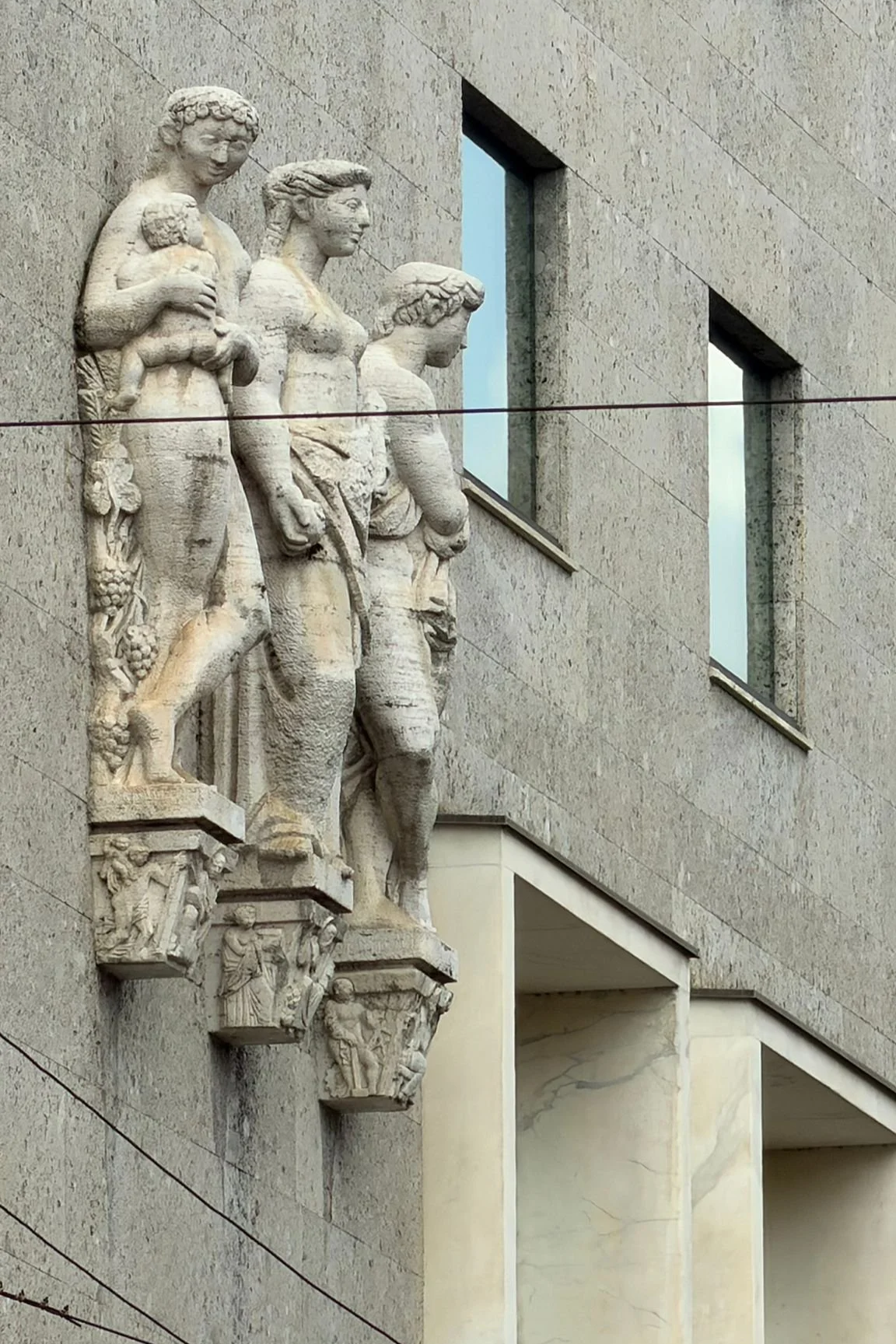
Architecture is one of the few disciplines through which a culture reveals what it values before it has found the language to explain it. A wall, a threshold, a room held in shadow, a courtyard open to sky - these are never neutral acts. They speak of protection, ritual and belonging. Often, it is only by leaving home that one begins to see more clearly what kind of architecture that home might require.
Returning to Europe, especially to cities as culturally dense as Milan and Paris, does not answer the question of Australian architecture, but it does sharpen it. Distance clarifies what is inherited, what is assumed, and what has settled into view without being properly examined. Looking back towards Australia from here, what comes into focus is the question our work has been trying to approach.
Walking past the Castello in Milan, it was not the monument itself, nor its ornament, that held my attention. It was the depth of the parapets, the weight of the walls and the darkness of the reveals. In those moments I found myself recalling the ruins of Caracalla in Rome, where civilisation appears not in its finished or triumphant state, but as residue. As husk, echo and remnant. Something once complete and emblematic, now stripped back to its essential condition.
There is something revealing in that state. When grandeur falls away, architecture becomes easier to read. Ornament disappears and symbols weaken, yet silhouette, proportion, mass, aperture and space remain. The essential things endure, and in their stripped state they feel both familiar and raw.
This matters to us because it clarifies something we have long been reaching towards. The forms that persist in our work are rarely complicated: a wall, a courtyard, an entry, a chimney, a marker in the landscape. They are not quotations from history or gestures of style, but primary figures, recognised almost before they are named. They carry an echo not because they belong to one culture, but because they sit deeper than style, within a more instinctive reading of space.
Perhaps that response is not only cultural, but biological. Human beings are hardwired to understand certain spatial conditions: prospect and refuge, threshold and enclosure, shadow and light, protection and exposure. These are things we know before language. Long before architecture became image, it was shelter. Long before it became style, it was boundary, opening, procession and room.
This is what we mean when we speak about the primal. We are not interested in primitive imagery, reduction as aesthetic exercise, or modernity stripped back once more. Our work is not trying to be modern. It is trying to be ancient.
By ancient, we do not mean historical imitation, borrowed Roman language or nostalgia for ruin. We mean something prior to style: an architecture shaped by first principles, by shelter before expression, mass before image and threshold before spectacle.
It is a way of building that can create calm, security, warmth and social ease through space itself.
In Australia, that search carries a particular weight. For those of us shaped by a Western inheritance yet practising on this ground, the question of architectural identity is not straightforward. The colonial frame no longer feels sufficient, yet inheritance cannot simply be discarded, nor can one claim a position that is not one’s own. For a non-Indigenous practice, this requires humility and care. It asks for an architecture less dependent on imported cultural codes and more attentive to place, climate, settlement and human need.
This is not a political proposition so much as an architectural one. It is a reflection on how we want to practise here, in Australia, with seriousness and respect. Rather than inventing a symbolic language, we are interested in returning to elemental spatial truths. In architecture that can be understood through the body. In work that offers security in the fullest sense: physical protection, emotional calm, clear orientation, healthy social encounter and the feeling of being held.
This is why depth matters. Why thick boundaries, controlled entry, protected courtyards, legible procession and heavy silhouette can carry such force. These are not merely compositional devices. They shape behaviour, settle the nervous system, and create the conditions for warmth, encounter, retreat and belonging. Before anything is placed within a room, the architecture itself can begin to establish comfort and compassion.
Looking back at Australia from Europe, what becomes clearer is not that one culture is richer and another poorer. It is that architecture here must often work harder to create depth, memory and security through space itself, without leaning on centuries of inherited form. That may be why we are drawn to a certain restraint. Not because less is fashionable, but because what matters most is what remains when everything extraneous falls away.
What remains is the part that resonates: the familiar but raw silhouette, the wall that shelters, the opening that gathers light, the courtyard that holds silence, the threshold that marks transition. These are the enduring elements. They do not belong to one age alone, but to architecture in its most fundamental state. Perhaps that is why ruins move us so deeply. They do not represent the past in full. They reveal what architecture still is after image, ornament and certainty have disappeared. They expose the primary act beneath the finished work.
For us, that is not a reference to copy, but a reminder of where to begin: not with style, novelty or modernity, but with the ancient idea that architecture exists first to hold life, to protect it, and to give it form.
Related projects: EPSC Residence, HMM Residence.
Related reading: Travel as Architectural Education & The Comfort of Mass
