
Warm Minimalism is not Absence
People often use “warm minimalism” when they are caught between two instincts. They want clarity, calm, and a contemporary home that feels resolved. At the same time, they fear something sterile, machine-like, or emotionally distant.
The misunderstanding is that restrained homes are defined by what is missing. In reality, the strongest homes in this territory are defined by what is present, and what has been chosen deliberately. Restraint is not a style of removal. It is a way of living with intention.
A restrained home can be deeply personal. It can be more engaging, not less, because every element is asked to carry weight. Light has a job to do. A threshold has a job to do. The palette must earn its place. When there are fewer moves, each move matters more.
Warmth is not decoration
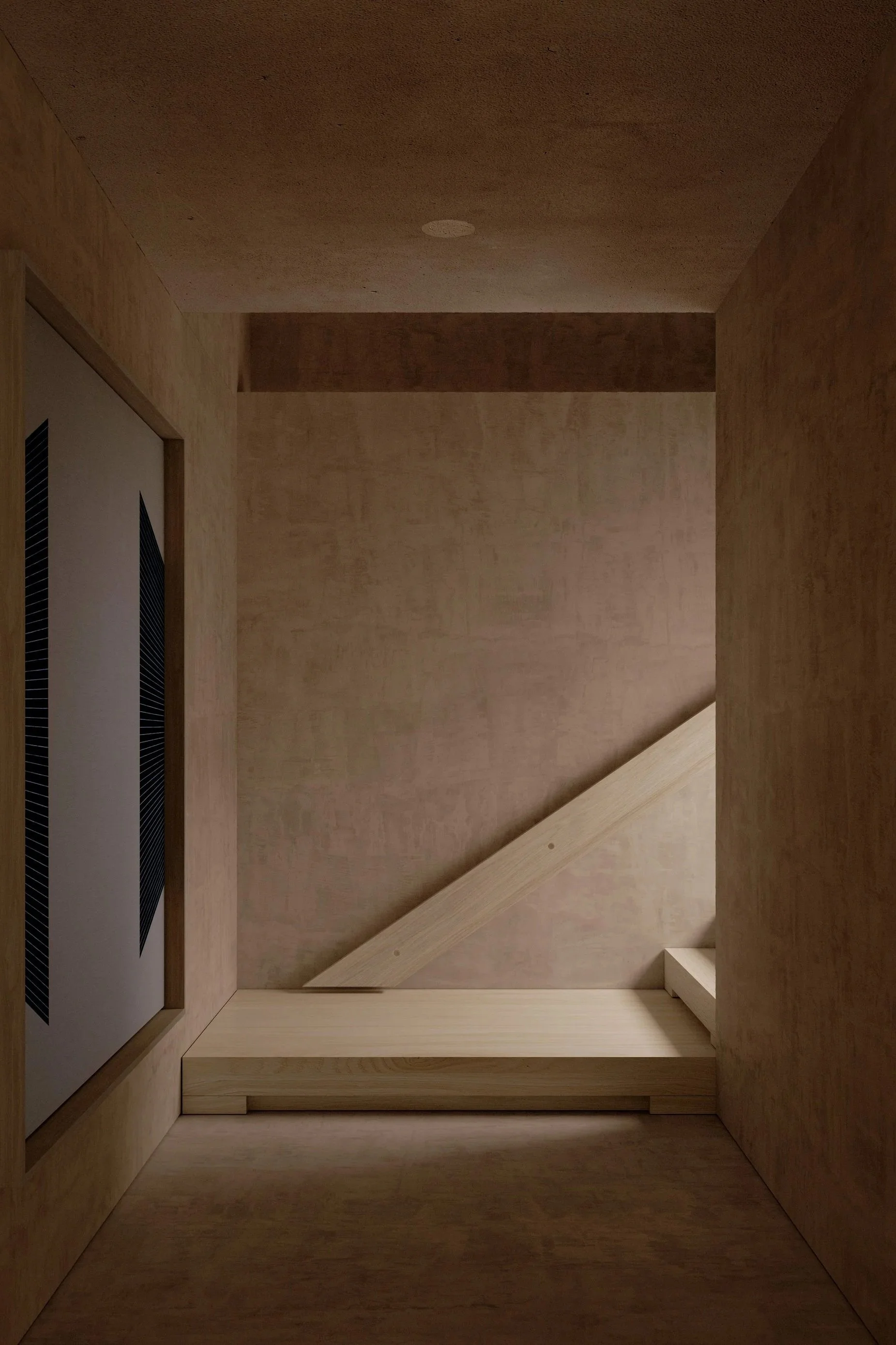
Warmth in architecture does not come from adding objects. It comes from how a space receives you. It comes from proportion and sequence, from softness and shadow, from the way surfaces carry light.
In our work, warmth is often held in a small number of materials that age well over time. Hard plaster, for its sheen and fine irregularity, is never flat. It changes across the day. It gives light something to catch. Terracotta carries character and variation and a certain casualness. It refuses to be sterile. Limestone has resilience and an understated luxury. It feels composed without needing to shout.
A restrained home is not impersonal. It is more deliberate, more profound, and in its own way, more pure. It frames daily life rather than competing with it. It does not ask to be noticed, yet it rewards attention. This way of living is not for everyone. But for those drawn to it, it brings clarity, order, and a quieter kind of richness.
The home as a vessel
We think of a home as a vessel for life. The role of architecture is not to dominate, but to support and heighten experience.
When a home is calm, you become more present. When the plan is coherent, you move through it without friction. When the palette is restrained, small changes become meaningful: morning light across plaster, the temperature of stone at dusk, the shadow of a reveal deepening as the day slows.
This is where restraint becomes more than a look. It becomes a discipline. It asks for editing. It asks for patience. It asks for fewer decisions done better.
It is easy to make something sparse. It is much harder to make something spare and generous at the same time.
Lineage, lightly
We understand that cultural shorthand for this approach sometimes leads people to designers and architects like Vincent Van Duysen or John Pawson. What we take from that lineage is not a style, but a sensibility - a focus on proportion and restraint, and a regard for light as a material in its own right. The aim is always to make spaces that feel inevitable, not composed.
Proof in our work
LPS Residence and HMM Residence show that restraint does not mean emptiness. They show how clarity can still be sensuous, how a small palette can still hold variation, and how atmosphere can be built from light, depth, and material honesty rather than ornament.
If we had to summarise our position simply, it would be this: warmth comes from intention. From what is chosen and protected, not from what is added.
Related projects: LPS Residence, HMM Residence, LDS II Residence.
Related pages: Residential architecture in Melbourne, Architecture as Interiors.
