

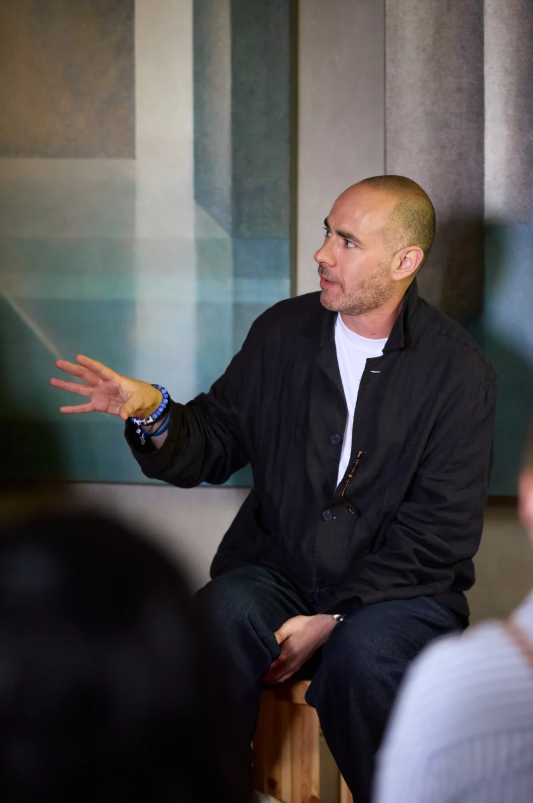
Photographed by Bernie Wright
Still Point
This piece began as a conversation.
Last month, Hannah Abbott from Otomys invited me to join a panel discussion with Helen Redmond as part of Still Point, the exhibition marking the gallery’s fifteenth anniversary. Sitting beside Helen, surrounded by her paintings, I realised that the themes we spoke about that afternoon reached far beyond the event. They touched on the foundations of my architectural education, the buildings that shaped me, and the way I think about light, order and restraint.
My connection to Helen’s work is longstanding. I have admired her paintings for many years and am fortunate to live with one. It hangs in our meeting room, directly behind me when we present projects. Her work feels familiar not because it depicts recognisable spaces, but because it captures something essential about how space behaves. The paintings are distilled rather than descriptive, built from simple forms and planes, yet animated by the way light moves across them. Shadows soften unexpectedly. A ceiling glows where logic suggests it should fall into shade. Surfaces hold both clarity and mystery. The work is neither photographic nor digital. It belongs to a different language, one that speaks in atmosphere rather than representation.
Seeing a new series that Helen had painted specifically for Villa Alba brought me back to an early moment in my training. When I finished my studies, a tutor encouraged me to visit two buildings: Peter Zumthor’s thermal baths at Vals and Le Corbusier’s monastery of La Tourette. I had studied them academically but experiencing them was transformative. I arrived at Vals late at night with no camera, which now feels like a gift. The next morning the building revealed itself slowly. Water tracked across stone. Light was treated almost as a rare commodity, slipping into dark corridors, halls and rooms in a way that amplified its presence. It was architecture understood not through image but through sensation, and it left an impression I have never quite shaken.
La Tourette offered a different lesson. Where Vals felt elemental in form, La Tourette was elemental in ritual and culture. Its concrete frames carved the sun into narrow intervals, dividing time as much as space. Light there was disciplined and structured, almost liturgical. Together, these two buildings taught me that architecture is not only the arrangement of volumes but the shaping of light, proportion and restraint. They formed the early architecture of my thinking long before I knew what my own work might become.
This is why Helen’s paintings struck me so strongly when I first encountered them. They echoed that early experience. They captured the way light misbehaves, how it ignores diagrams and reveals unexpected qualities within the simplest forms. Her work is a study of what happens when form becomes a vessel for atmosphere. In that sense, the paintings feel closer to architecture than to image making. They are a reminder that light is always the true subject.
In our practice, this pursuit of light is shaped by constraint. Every project begins with a site, a family, a budget and a set of competing needs. These limits are not obstacles. They are the conditions through which meaning emerges. Within them lies the opportunity to create spaces that breathe, that register the seasons and the passing of the day. The most poetic moments often occur in the in-between spaces, the corridor, the entry, the stair. These are the places where contrast, shadow and proportion can work quietly and powerfully.
Technology has changed how we communicate this intention. For years, restraint was difficult to show. Clients would look at early renders and search for the design, assuming that simplicity meant incompleteness. As our ability to model the movement of natural and artificial light has improved, we can now show how a room transforms across the day, how material and light work together, how clarity can be more expressive than complexity. Light becomes the organising principle.
During the panel at Otomys, we spoke about this shared territory between painting and architecture. Sitting among Helen’s work, I was reminded that both disciplines are attempts to capture the intangible. Both search for that moment of alignment when form and light settle into equilibrium. In architecture I often think of this as the still point, the moment a project reveals its essence, when proportions start to cohere and the dread of the blank page turns into the excitement of emergence.
This is the pursuit that connects Vals, La Tourette, Helen’s work and our own practice. It is the search for clarity within complexity, for atmosphere within structure, for light as the quiet protagonist. The buildings that shaped me early on taught me that architecture becomes meaningful when it transcends function and enters the realm of experience. Helen’s paintings remind me of this every day.
Related projects:LDS Residence I, RZTK Residence.
